Independent setup & troubleshootingHelping you find your connection.
The guide library

Static WAN IP setup: check the entire address set

Explore the guide library · Installation planning

A provider-assigned static connection needs matching address, mask, gateway and DNS details, not a copied address from another network.
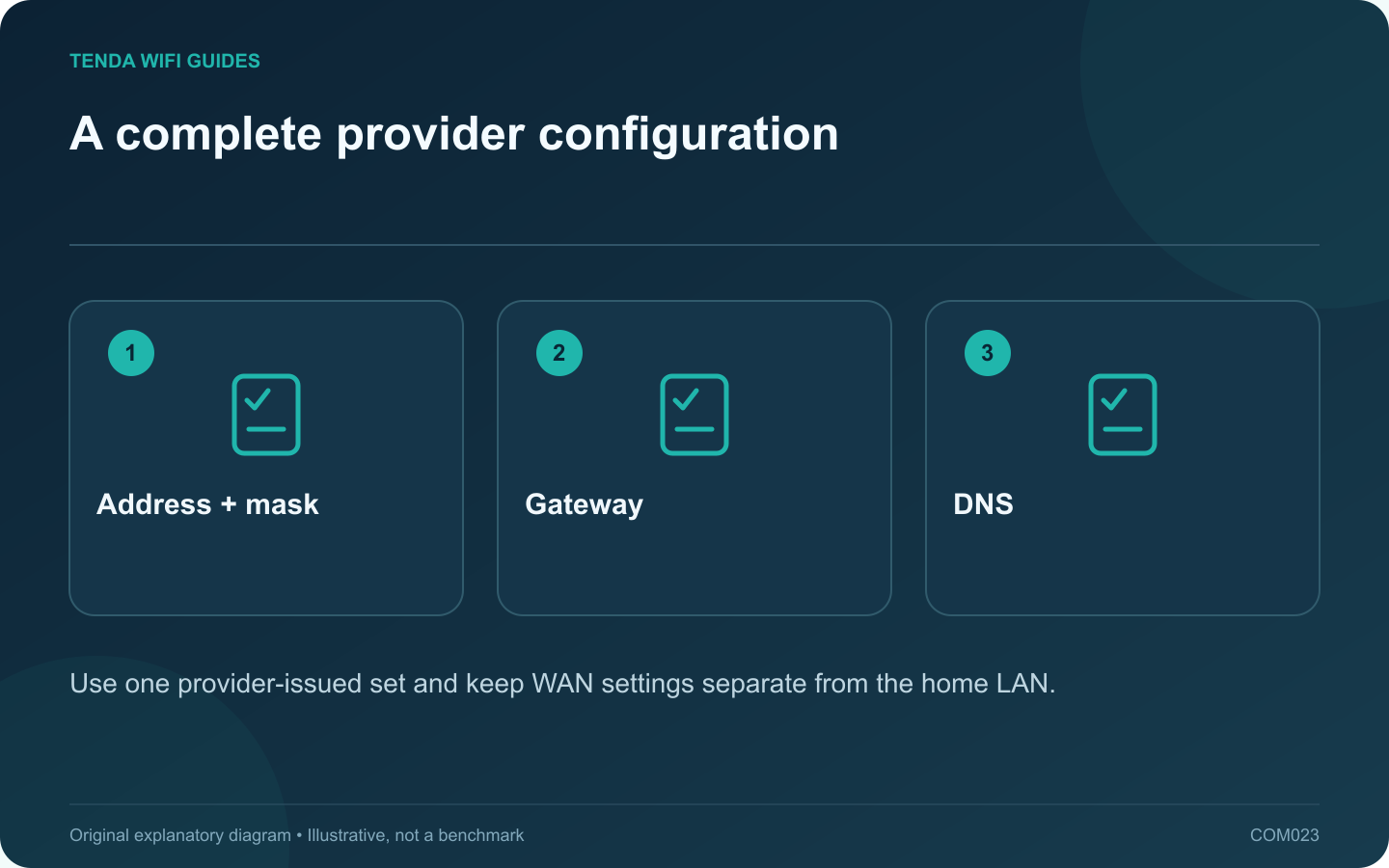
A complete provider configuration: Address + mask; Gateway; DNS
Use one provider-issued set and keep WAN settings separate from the home LAN.

Choose static WAN addressing only when your ISP or network administrator has supplied the required configuration. Copying a working computer’s private address into the router’s internet page is not a substitute. The address, network mask, gateway and DNS details must belong to the intended service handoff.

Keep WAN and LAN records separate

The WAN side connects to the upstream service. The LAN side serves your household devices. Label both clearly in the setup record so a local printer address does not end up in the internet configuration.

Tenda’s F3 static-IP instructions require the settings supplied by the provider. The old screenshots apply to that documented model; use your own router’s current manual for the screen layout. Do not copy an example’s default password or address as a universal configuration.

Verify the values before saving

  1. Compare each field against the provider’s written information, including punctuation and mask or prefix notation.
  2. Confirm that the specified gateway belongs to the intended upstream arrangement.
  3. Record the prescribed DNS servers and whether the provider allows alternatives.
  4. Check for additional service requirements such as VLAN configuration.
  5. Retain the previous working settings so the change can be reversed.

Read the result in stages

If the WAN cable is not detected, correct that physical link before editing address fields. If the link is present but service does not work, capture the connection status and compare the entered values again. Test a normal website from one client after the router reports a suitable connection.

Do not change the home LAN subnet, clone a device address and replace DNS all at once. Each change should have a reason tied to the provider instructions or a specific observed conflict.

When the record is incomplete

Ask the provider to complete or confirm the address set. Guessing can create conflicts or make the failure harder to diagnose. A static service is not inherently a speed upgrade; it is a particular addressing arrangement that must be configured correctly.

Sources and editorial notes

Sources checked 8 October 2026. Independent guidance and original illustrations; product comparisons use published specifications rather than hands-on benchmarks. Check the exact model, revision and regional documentation before changing settings.

Related guides

300 FAQs across our guide libraries

Quick answers

100 practical questions from Tenda WiFi Guides.

Browse all 100 FAQs
Which details are needed for a static WAN address?

Choose static WAN addressing only when your ISP or network administrator has supplied the required configuration. Copying a working computer's private address into the router's internet page is not a substitute. The address, network mask, gateway and DNS details must belong to the intended service handoff. The WAN side connects to the upstream service. The LAN side serves your household devices. Label both clearly in the setup record so a local printer address does not end up in the internet configuration.

Read the full guide and sources
Which ISP settings should I collect before changing routers?

The fastest router installation often begins before any cable is unplugged. Collect the provider-specific information while the old network still works. This avoids guessing at the setup wizard and makes a failed migration easier to reverse. Identify whether the router receives Ethernet from a modem, optical terminal, wall socket or another gateway. Note the device and port at the far end of the cable. A fiber service does not necessarily mean that your retail router connects directly to the fiber.

Read the full guide and sources
Can a replacement router reuse my existing Wi-Fi name and password?

Keeping the same wireless name and password can make a router replacement easier, but it does not clone the old network. The new router still has its own address plan, security settings and feature behavior. Treat automatic reconnection as a convenience to verify, not a guarantee. Save the exact network name, including capitalization, and the security mode. Record reservations, local storage paths, guest settings and any provider configuration separately. Apple recommends consistent, unique wireless naming for its devices; avoid retaining a confusing generic default name solely to save a few minutes.

Read the full guide and sources
Are PPPoE, Wi-Fi and router-administration passwords interchangeable?

A router installation can involve three different passwords. The ISP credential establishes the internet service, the Wi-Fi credential lets devices join the wireless network, and the router administrator credential protects configuration changes. Reusing the wrong one produces a failure at a different stage. When a setup wizard requests PPPoE details, use the account information supplied by the ISP. Tenda's setup guide explicitly separates that step from the wireless and management configuration. A password that successfully connects your phone to Wi-Fi is not evidence that it can authenticate the internet connection.

Read the full guide and sources
Independent. Practical. Clear.

Tenda WiFi Guides is an independent information website. We are not affiliated with or endorsed by Tenda. Product names belong to their respective owners.