Explore the guide library · Router buying guides
Compare the traffic your household creates rather than choosing a router solely by an advertised connected-device total.
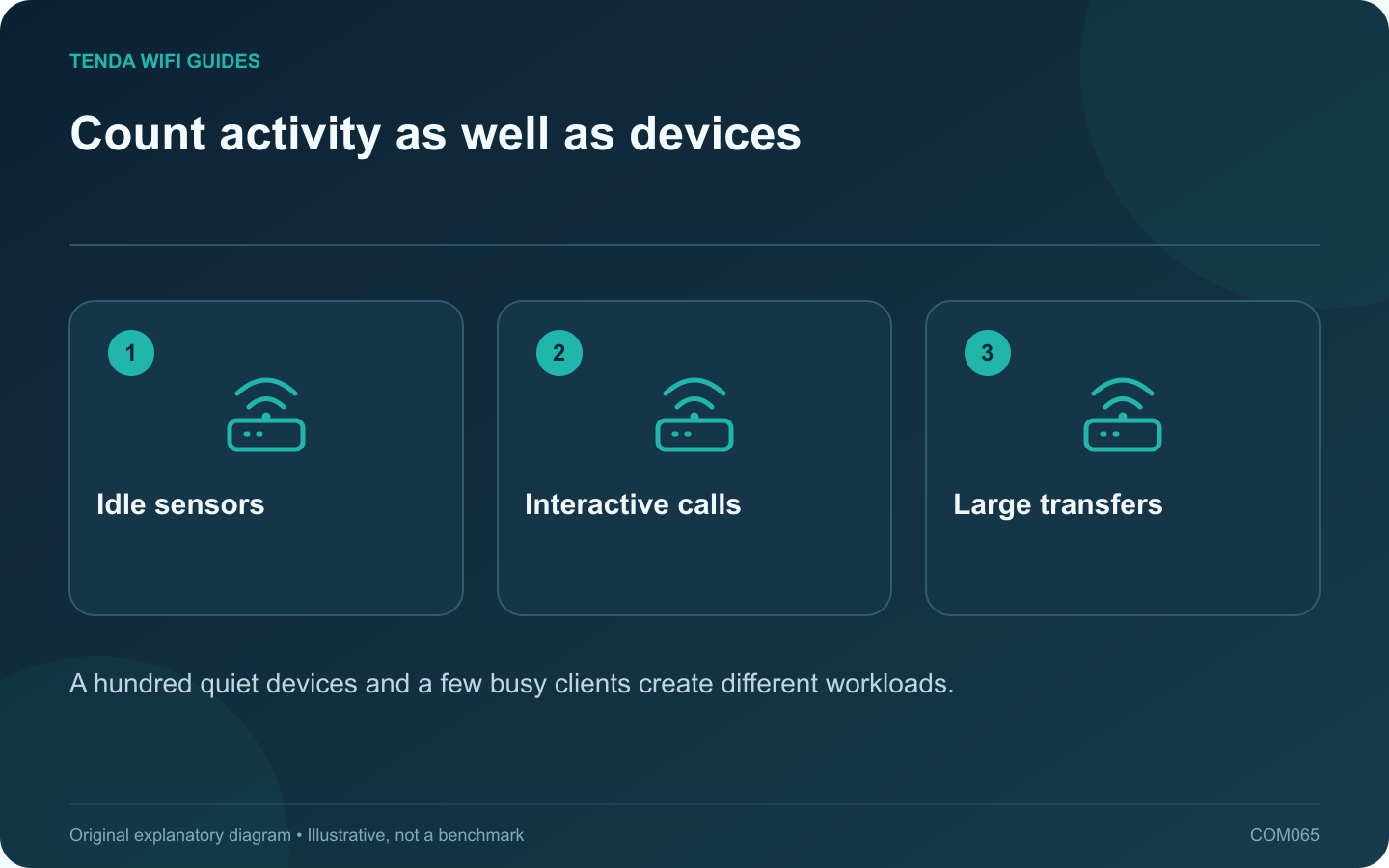
An advertised connected-device count can help describe a product category, but it does not tell you how the router will handle your household’s simultaneous work. A collection of quiet sensors creates a different demand from several large uploads and interactive calls.
Build an activity inventory
Group devices by the work they perform: occasional control messages, streaming, calls, gaming, backups and local transfers. Mark which tasks happen together and which must remain responsive. This is more useful than adding every device in the client list and comparing the total with a box headline.
Manufacturers publish device or user-capacity figures for products such as Deco BE63 and Tenda W18E. Treat those as qualified specifications, not as a guarantee that every listed client can perform a demanding task simultaneously.
Locate the shared constraints
- The provider’s upload and download service.
- The wireless airtime used in each important room.
- The link between access points or mesh nodes.
- Switch and storage connections for local work.
- The router features enabled while traffic is processed.
Test a representative busy period
Use the normal work laptop for a call while another household device performs a typical backup or download. Check the distant television or console if it is part of the usual evening load. Record responsiveness and interruptions, not just aggregate transfer volume.
Do not create unnecessary traffic on a capped service merely to maximize a test. Choose a controlled workload that resembles real use.
Buy for the failure you observe
If the upstream upload is saturated, investigate scheduling or supported queue management. If a distant node has a weak backhaul, examine placement or wiring. If one old client fails while others work, inspect that client before replacing the whole network.
The best router for a busy household is part of a complete topology that supports its actual tasks. A large device-count claim alone cannot establish that fit, and adding more idle devices is not a substitute for a realistic acceptance test.
Sources and editorial notes
Sources checked 8 October 2026. Independent guidance and original illustrations; product comparisons use published specifications rather than hands-on benchmarks. Check the exact model, revision and regional documentation before changing settings.