Independent setup & troubleshootingHelping you find your connection.
The guide library

The home-office router checklist: calls, recovery and local control

Explore the guide library · Router buying guides

Choose a work-from-home router around reliable calls, a documented recovery path and compatible backup service.
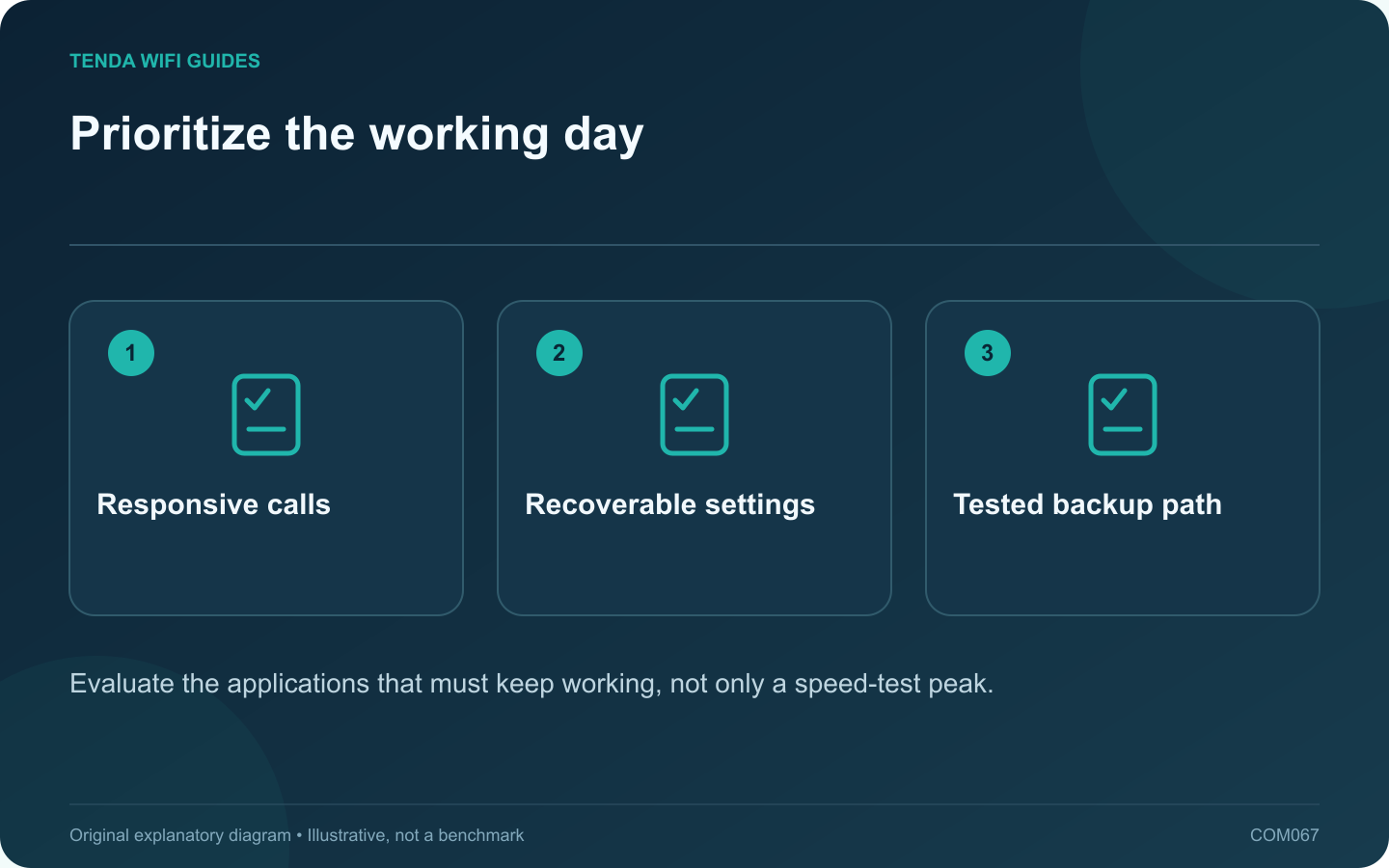
Prioritize the working day: Responsive calls; Recoverable settings; Tested backup path
Evaluate the applications that must keep working, not only a speed-test peak.

A good home-office router makes interruptions easier to prevent and diagnose. Before comparing models, write down the work applications, number of simultaneous calls and the household traffic that overlaps with them. Include the employer’s VPN requirements without putting confidential configuration details in a public support request.

Check the busy-hour behavior

Run a normal call while another device performs a typical upload. If responsiveness deteriorates, investigate supported queue management and the upstream service. GL.iNet documents SQM as a model-dependent feature with processing costs; it is not available identically on every router.

Plan recovery before adding features

  • Use a supported local administration method.
  • Keep a private copy of the configuration and provider details.
  • Know how to identify the router’s current local address.
  • Arrange a maintenance window for firmware updates.

Cloud convenience can be useful, but a cloud outage should not leave you without a documented local troubleshooting route where the product supports one.

Evaluate backup connectivity honestly

If a second connection is essential, verify the exact router supports the required WAN interface and failover behavior. A dual-WAN label does not promise an existing call survives a public-address change. Test reconnection in the actual conferencing and work applications during a quiet period.

Check whether both services depend on the same building power or physical access line. A second bill does not automatically buy an independent failure path.

Write an acceptance sheet

Record call quality at the work desk, local printer access, VPN compatibility, outage recovery and the time needed to restore normal service. Include a wired fallback if practical. Keep household access rules understandable to someone else who might need to administer the network.

Choose the device that satisfies these checks at a sustainable cost. This approach may favor a modest router with appropriate management and cabling over a more expensive model whose additional radio features do not address the office’s actual weak point.

Sources and editorial notes

Sources checked 8 October 2026. Independent guidance and original illustrations; product comparisons use published specifications rather than hands-on benchmarks. Check the exact model, revision and regional documentation before changing settings.

Related guides

300 FAQs across our guide libraries

Quick answers

100 practical questions from Tenda WiFi Guides.

Browse all 100 FAQs
Which router features matter most for a home office?

A good home-office router makes interruptions easier to prevent and diagnose. Before comparing models, write down the work applications, number of simultaneous calls and the household traffic that overlaps with them. Include the employer's VPN requirements without putting confidential configuration details in a public support request. Run a normal call while another device performs a typical upload. If responsiveness deteriorates, investigate supported queue management and the upstream service. GL.iNet documents SQM as a model-dependent feature with processing costs; it is not available identically on every router.

Read the full guide and sources
Does an advertised device count describe real router capacity?

An advertised connected-device count can help describe a product category, but it does not tell you how the router will handle your household's simultaneous work. A collection of quiet sensors creates a different demand from several large uploads and interactive calls. Group devices by the work they perform: occasional control messages, streaming, calls, gaming, backups and local transfers. Mark which tasks happen together and which must remain responsive. This is more useful than adding every device in the client list and comparing the total with a box headline.

Read the full guide and sources
How can I test a new router during its return period?

Decide what success looks like before replacing the old router. Otherwise, a strong first speed test can hide a printer that no longer works, unstable calls in the office or a missing feature. A return-period test should cover the household's real tasks and the capabilities that justified the purchase. Choose a near-router position, the main work area and the weakest important room. Use the same laptop or phone in each. Record an ordinary internet transfer, a video call and any local storage task that matters. Note the time and whether other household traffic was active.

Read the full guide and sources
What should I check before relying on router parental controls?

Parental controls vary substantially between routers and service plans. Before purchasing, write down the behavior you need: a bedtime schedule, a category filter, a pause button or visibility into connected devices. These are different requirements, even when grouped under one menu name. Read which functions are included, which require an account or subscription and what remains after a trial ends. Confirm the features work in the intended router or access-point mode. TP-Link documents mode-dependent Deco features, while Tenda lists parental controls among supported RX2 Pro functions; neither label alone answers every household policy question.

Read the full guide and sources
Independent. Practical. Clear.

Tenda WiFi Guides is an independent information website. We are not affiliated with or endorsed by Tenda. Product names belong to their respective owners.