Independent setup & troubleshootingHelping you find your connection.
The guide library

Before buying a 6 GHz router, check the whole client chain

Explore the guide library · Wi-Fi upgrades

Check the computer or phone, operating system, drivers and region so a new 6 GHz router delivers a usable connection.
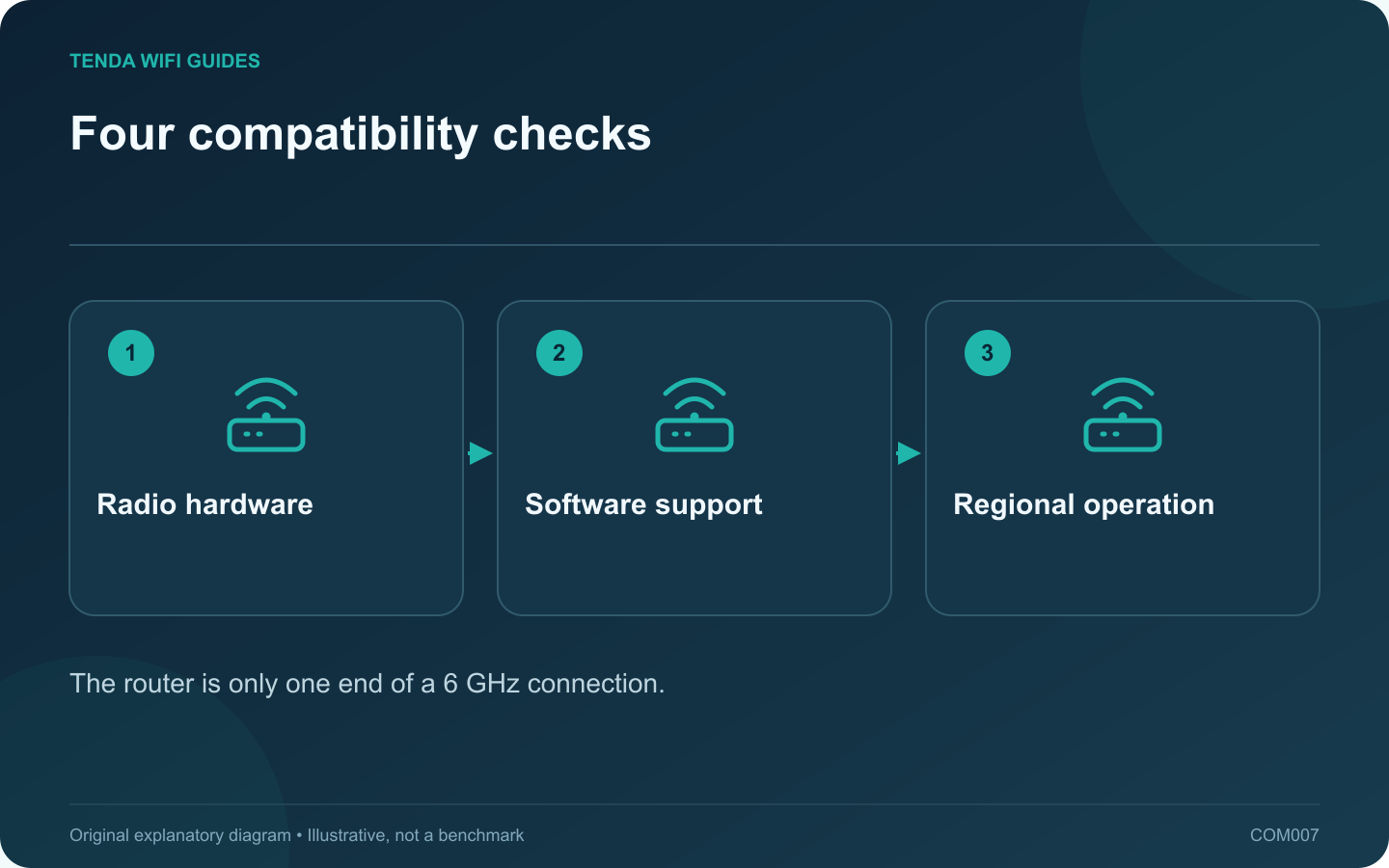
Four compatibility checks: Radio hardware; Software support; Regional operation
The router is only one end of a 6 GHz connection.

A router with a 6 GHz radio cannot add 6 GHz support to an older phone or laptop. Before spending money, identify at least one device that can use the extra band. Treat the client as a combination of hardware, software and regional support, rather than relying on the device’s age.

Collect the exact identity

For a computer, find the wireless adapter model and the manufacturer’s current driver information. For a phone or tablet, use the specification for the exact generation and regional variant. A similar product name is not enough.

Record the operating-system version next. Microsoft’s Windows guidance distinguishes the software requirements for newer Wi-Fi capabilities. Do not assume that installing a new adapter while retaining an older software environment activates every feature.

Separate basic access from advanced features

Joining a 6 GHz network and using a Wi-Fi 7 feature are different checks. A client may support the band without supporting the router’s advertised multi-link or widest-channel mode. TP-Link explicitly conditions advanced BE63 features on client support and regional availability.

On a buying worksheet, give each feature its own entry: 6 GHz access, intended channel width and MLO mode. Mark unknowns as unknowns until the client documentation resolves them.

Verify after installation

  1. Set up the router using its regional instructions and current supported firmware.
  2. Connect the known-compatible test client near the router.
  3. Inspect the connection details supplied by the client or router. Record the actual band instead of inferring it from the network name.
  4. Move to the usual work position and repeat the intended task. Include the ordinary location in the acceptance test.

If the band is unavailable, stop changing unrelated DNS or internet settings. Return to the adapter, software, router band configuration and regional documentation. Those checks address the missing radio connection directly.

Keep older household devices on their supported bands. Their continued operation is part of a successful upgrade; forcing every device onto one new configuration is not the objective.

Sources and editorial notes

Sources checked 8 October 2026. Independent guidance and original illustrations; product comparisons use published specifications rather than hands-on benchmarks. Check the exact model, revision and regional documentation before changing settings.

Related guides

300 FAQs across our guide libraries

Quick answers

100 practical questions from Tenda WiFi Guides.

Browse all 100 FAQs
What must support 6 GHz before I buy a compatible router?

A router with a 6 GHz radio cannot add 6 GHz support to an older phone or laptop. Before spending money, identify at least one device that can use the extra band. Treat the client as a combination of hardware, software and regional support, rather than relying on the device's age. For a computer, find the wireless adapter model and the manufacturer's current driver information. For a phone or tablet, use the specification for the exact generation and regional variant. A similar product name is not enough.

Read the full guide and sources
What should I check before turning on Wi-Fi 7 MLO?

Multi-link operation, or MLO, lets compatible Wi-Fi 7 equipment coordinate more than one wireless link. The important buying question is not simply whether MLO appears on the box. Ask which bands, radio modes and client software participate in the connection you intend to use. Intel distinguishes a single-radio approach, eMLSR, from a multi-radio approach. The former can use alternative channels with one client radio; the latter can support simultaneous links. That distinction explains why two devices bearing the same Wi-Fi generation label may not deliver identical results.

Read the full guide and sources
When are 320 MHz Wi-Fi channels useful?

A 320 MHz channel is a capability to evaluate for demanding wireless transfers, not a setting every household needs to maximize. The first question is whether both the router and the device can actually use it in your region. The second is whether the rest of the transfer path has enough capacity to benefit. For example, TP-Link specifies that the Deco BE63's 320 MHz operation is on 6 GHz and depends on compatible clients and regional availability. A router described simply as Wi-Fi 7 may use only 2.4 GHz and 5 GHz. Check the band list before comparing channel widths.

Read the full guide and sources
Does a 4K-QAM label guarantee faster internet?

4K-QAM is a Wi-Fi 7 radio capability, not a separate internet plan or a guarantee that a download becomes four times faster. The label describes how information can be carried by the wireless signal. Buying advice becomes misleading when that technical feature is presented as a whole-network speed result. Intel includes 4K-QAM among Wi-Fi 7's capacity improvements. On your comparison worksheet, place it under radio features. Keep measured performance, Ethernet port rates, coverage requirements and subscription costs in separate columns. Mixing those categories makes it easy to count the same marketing benefit twice.

Read the full guide and sources
Independent. Practical. Clear.

Tenda WiFi Guides is an independent information website. We are not affiliated with or endorsed by Tenda. Product names belong to their respective owners.