Independent setup & troubleshootingHelping you find your connection.
The guide library

A router upgrade plan for a rental home

Explore the guide library · Installation planning

Improve your own network while preserving provider equipment, landlord requirements and an easy move-out path.
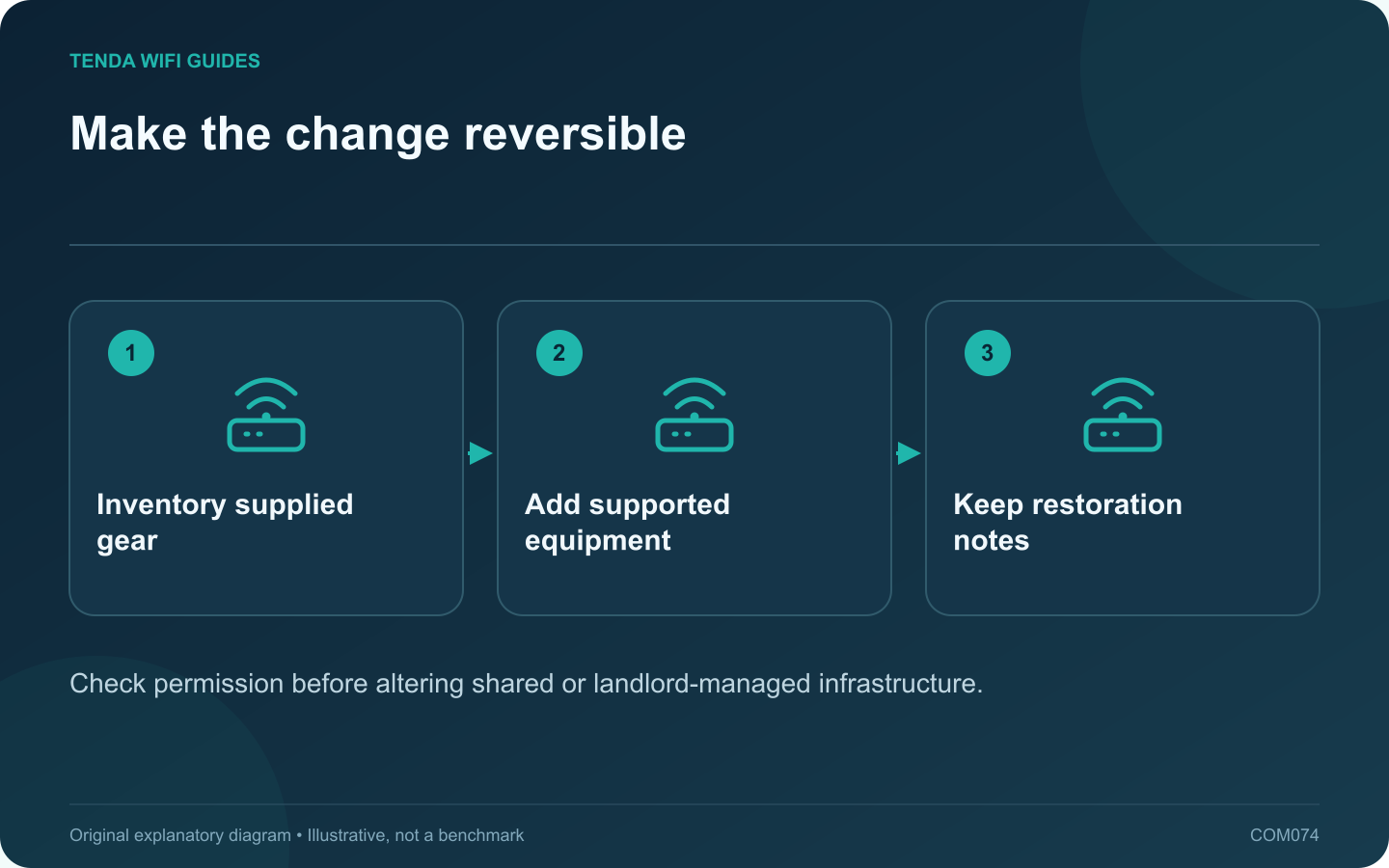
Make the change reversible: Inventory supplied gear; Add supported equipment; Keep restoration notes
Check permission before altering shared or landlord-managed infrastructure.

A rental-home network upgrade should fit the connection you are allowed to administer. Start by distinguishing your own equipment from landlord-managed or shared infrastructure. Do not change a shared gateway, wiring cabinet or building network without the responsible party’s permission.

Identify the boundary

Is your service a private provider connection, an Ethernet outlet supplied by the building, or access to shared Wi-Fi? Record what you control and what must remain. A router suitable for one arrangement may be awkward or unsupported in another.

Choose an appropriate operating role

For a private gateway that must stay, a supported access-point arrangement may improve wireless coverage while leaving routing upstream. Bridge mode is a different decision that depends on provider equipment and service features. Read the relevant documentation before treating the terms as interchangeable.

A travel router can sometimes serve a temporary permitted connection, but it remains subject to the upstream network’s rules and capacity. It should not be used to evade access restrictions.

Prefer removable improvements

  • Place equipment on stable, ventilated furniture.
  • Use permitted cable routes that do not damage surfaces or create trip hazards.
  • Label your own adapters and power supplies.
  • Keep the supplied equipment and original configuration information.

Test the room you actually use

Check calls and normal transfers at the desk before purchasing more hardware. If the connection is shared, test at representative hours and avoid excessive speed testing that disrupts other residents.

Prepare for moving out

Keep a short diagram of the original arrangement and a list of your added devices. Remove personal configuration from equipment you sell or leave behind using its supported process, and restore supplied equipment only according to the owner’s instructions.

The right upgrade improves the tasks you need today while remaining simple to remove. A clear ownership boundary and reversible installation are more valuable than buying the largest router before understanding the rental’s connection arrangement.

Sources and editorial notes

Sources checked 8 October 2026. Independent guidance and original illustrations; product comparisons use published specifications rather than hands-on benchmarks. Check the exact model, revision and regional documentation before changing settings.

Related guides

300 FAQs across our guide libraries

Quick answers

100 practical questions from Tenda WiFi Guides.

Browse all 100 FAQs
How can I plan a router upgrade in a rental home?

A rental-home network upgrade should fit the connection you are allowed to administer. Start by distinguishing your own equipment from landlord-managed or shared infrastructure. Do not change a shared gateway, wiring cabinet or building network without the responsible party's permission. Is your service a private provider connection, an Ethernet outlet supplied by the building, or access to shared Wi-Fi? Record what you control and what must remain. A router suitable for one arrangement may be awkward or unsupported in another.

Read the full guide and sources
What should I check before bridging an ISP gateway?

Bridge mode can be useful when your own router should manage the home network. It is not a universal speed improvement. Before enabling it, confirm that the provider supports the arrangement and prepare the new router to take over the functions the gateway will stop providing. TP-Link's overview explains that gateway bridge mode hands routing to a separate router and may disable the gateway's Wi-Fi. The actual behavior depends on the provider equipment. Confirm the effects on telephone service, television equipment and local management access before altering a combined service gateway.

Read the full guide and sources
What if my home phone connects to the ISP router I want to replace?

If a home telephone plugs into the provider's gateway, replacing that gateway can affect more than Wi-Fi. Identify how the voice service is delivered before disconnecting equipment or enabling bridge mode. A retail Ethernet router may not provide the required telephone interface or provisioning. Record the telephone connection, television equipment and any other provider-managed devices. Note which gateway ports they use. Do not assume a telephone socket and an Ethernet socket are interchangeable because they look similar from a distance.

Read the full guide and sources
Which features might disappear in access-point mode?

Use access-point mode when the existing gateway should keep managing the network and the added device should provide wireless access. Use router mode when the new device must take over the gateway role. The decision affects more than the Wi-Fi name: some features depend on where traffic is routed. Write down the controls you rely on, such as reservations, parental rules, VPN routing and guest isolation. Beside each, identify the device that will enforce it after the change. A feature visible in a product advertisement may not be available in every operating mode.

Read the full guide and sources
Independent. Practical. Clear.

Tenda WiFi Guides is an independent information website. We are not affiliated with or endorsed by Tenda. Product names belong to their respective owners.