Independent setup & troubleshootingHelping you find your connection.
The guide library

Reserve a printer’s IP address before building shortcuts around it

Explore the guide library · Local network setup

Give a network printer a predictable DHCP address and verify it after reconnecting, without creating a competing manual address.
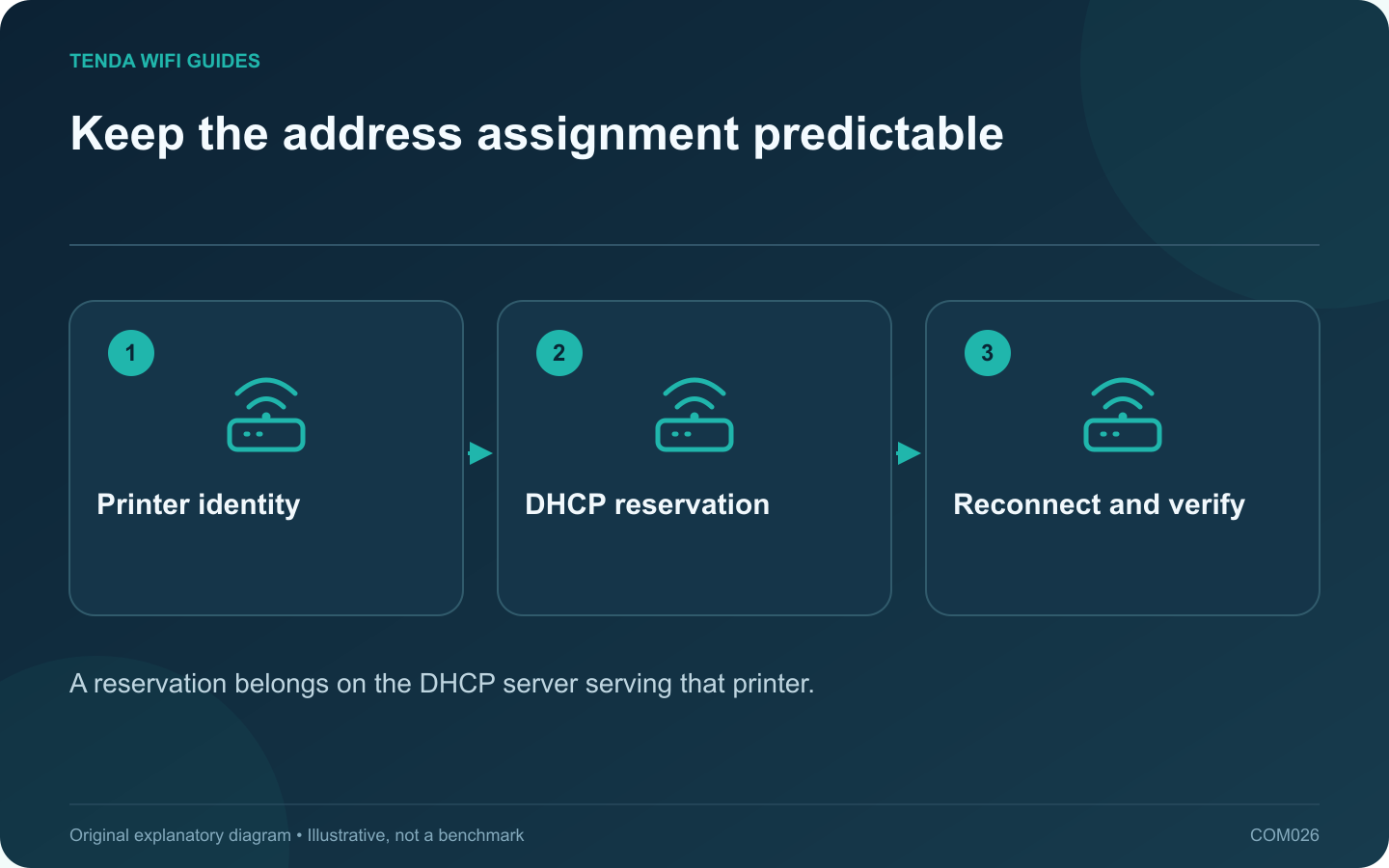
Keep the address assignment predictable: Printer identity; DHCP reservation; Reconnect and verify
A reservation belongs on the DHCP server serving that printer.

A printer shortcut becomes fragile when it points to an address that later changes. A DHCP reservation can make the address predictable while leaving the printer on automatic network configuration. Set it on the device that actually supplies DHCP to the printer, not automatically on whichever access point is nearest.

Identify the correct printer interface

Read the printer’s network report and compare it with the router’s client list. A printer with Ethernet and Wi-Fi can have different interface identities. Reserve the interface you intend to use, then give the entry a recognizable label such as office printer.

GL.iNet’s LAN guide describes reservations as repeatable DHCP assignments and notes that clients must reconnect for a new reservation to take effect. Other products may present the control under a different name.

Make one controlled change

  1. Record the current printer address, connection type and working print queue.
  2. Select an appropriate address using the router’s supported reservation workflow.
  3. Check that the address is not already assigned manually to another device.
  4. Save the reservation and reconnect or restart the printer as its manual permits.
  5. Read the printer’s current network report again before changing computer shortcuts.

Test the whole workflow

Print a simple page from the usual computer. Then let the printer sleep and wake it for another job. If scanning or a mobile printing app matters, test those separately; a successful print does not establish that every discovery feature works.

A reservation stabilizes an address. It does not change a guest-network restriction, repair a printer driver or grant access through a firewall.

Keep the inventory synchronized

If you later switch the printer from Wi-Fi to Ethernet, revisit the reservation instead of assuming it follows the physical device automatically. Remove an obsolete reservation only after confirming the old interface is no longer used.

Keep this record with your router migration notes. A replacement router needs its own deliberate reservation configuration; it does not inherit the old device’s DHCP database by recognizing the same Wi-Fi name.

Sources and editorial notes

Sources checked 8 October 2026. Independent guidance and original illustrations; product comparisons use published specifications rather than hands-on benchmarks. Check the exact model, revision and regional documentation before changing settings.

Related guides

300 FAQs across our guide libraries

Quick answers

100 practical questions from Tenda WiFi Guides.

Browse all 100 FAQs
Why reserve a printer’s IP address?

A printer shortcut becomes fragile when it points to an address that later changes. A DHCP reservation can make the address predictable while leaving the printer on automatic network configuration. Set it on the device that actually supplies DHCP to the printer, not automatically on whichever access point is nearest. Read the printer's network report and compare it with the router's client list. A printer with Ethernet and Wi-Fi can have different interface identities. Reserve the interface you intend to use, then give the entry a recognizable label such as office printer.

Read the full guide and sources
Should I use a DHCP reservation or a manual static address?

For an ordinary home device that needs a predictable address, a DHCP reservation is often easier to maintain because the router holds the assignment. A manual static address lives on the client instead. Either can be appropriate, but mixing them without an address plan creates avoidable confusion. With a reservation, the client still requests its configuration from DHCP and the server selects the reserved address. GL.iNet documents this behavior in its LAN guide. With a manual client configuration, you must maintain the address and the associated network settings on that device.

Read the full guide and sources
How do I choose the size of my DHCP address pool?

A home network's DHCP pool needs enough addresses for the clients that may connect, including devices you do not use every day. Count the network interfaces and visitors, not just the number of people in the house. A full pool can prevent a new device from receiving a useful configuration even while existing devices remain online. Compare the router's current client list with a room-by-room list of televisions, speakers, printers, cameras, consoles and computers. Include wired devices. Note occasional equipment such as a work laptop or visiting family phone that may not appear in today's online list.

Read the full guide and sources
Does Dynamic DNS make a home service reachable automatically?

Dynamic DNS keeps a hostname associated with a changing address. It does not, by itself, create an inbound route, remove provider address sharing or make a local service safe to expose. Treat naming, reachability and service authentication as separate checks. Use the dynamic-DNS provider's documented status and lookup process to confirm that the hostname points to the intended current address. GL.iNet's DDNS guidance directs users to compare the active WAN information and includes interactions with VPN settings. Follow the version-specific instructions for your device.

Read the full guide and sources
Independent. Practical. Clear.

Tenda WiFi Guides is an independent information website. We are not affiliated with or endorsed by Tenda. Product names belong to their respective owners.