Independent setup & troubleshootingHelping you find your connection.
The guide library

Size a home DHCP pool without guessing how many devices you own

Explore the guide library · Local network setup

Count active and occasional clients, check reservations and distinguish a full address pool from a weak Wi-Fi signal.
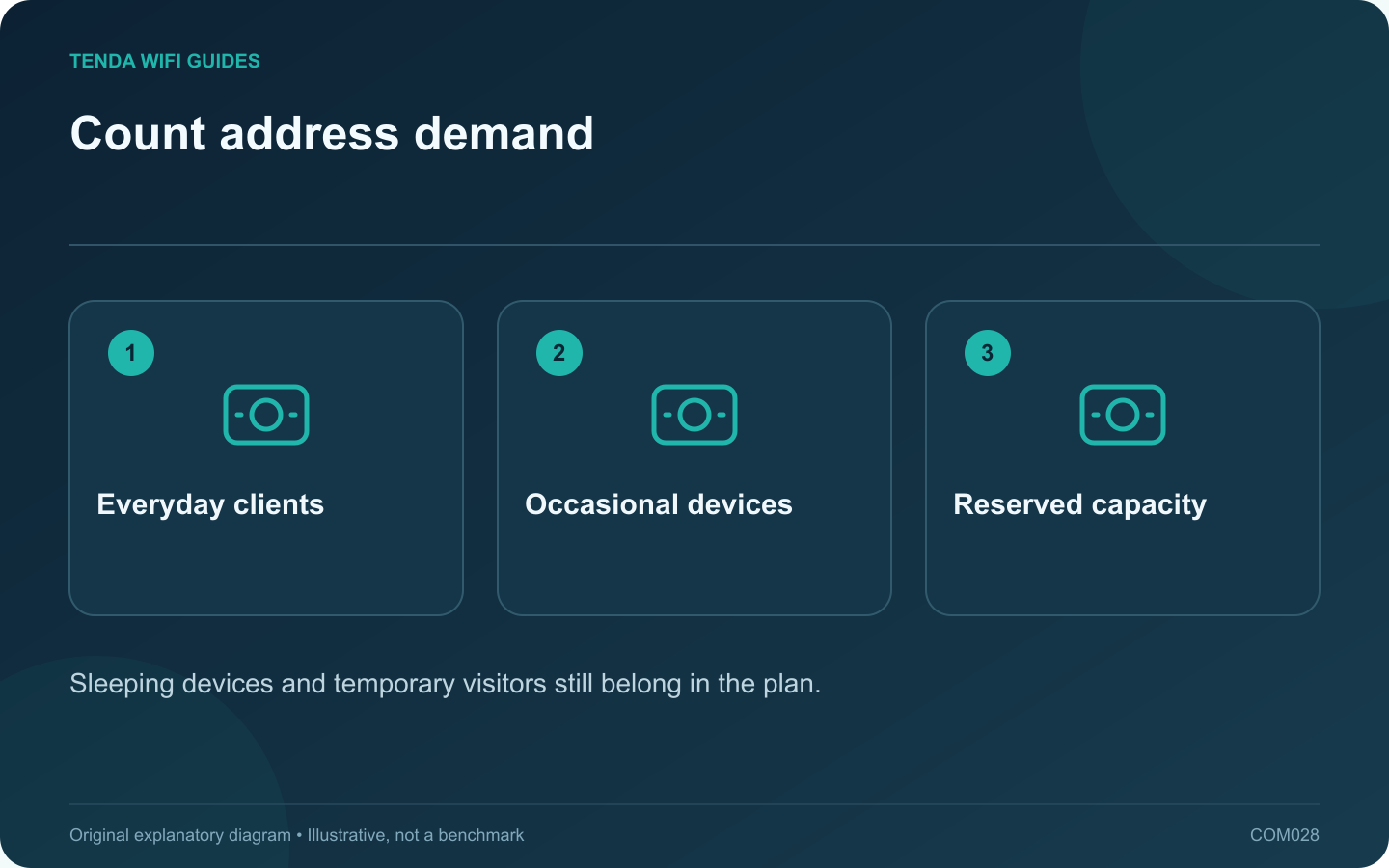
Count address demand: Everyday clients; Occasional devices; Reserved capacity
Sleeping devices and temporary visitors still belong in the plan.

A home network’s DHCP pool needs enough addresses for the clients that may connect, including devices you do not use every day. Count the network interfaces and visitors, not just the number of people in the house. A full pool can prevent a new device from receiving a useful configuration even while existing devices remain online.

Make an inventory from two views

Compare the router’s current client list with a room-by-room list of televisions, speakers, printers, cameras, consoles and computers. Include wired devices. Note occasional equipment such as a work laptop or visiting family phone that may not appear in today’s online list.

GL.iNet separates DHCP configuration and reservations in its LAN controls, and provides a separate DHCP section for its guest network. Check whether your own product also separates those address spaces before adding the counts together.

Inspect the existing pool

  1. Record the LAN subnet and the DHCP start and end addresses.
  2. Identify reservations and manually configured devices.
  3. Compare the available range with your expected simultaneous and recently connected clients.
  4. Review lease behavior using the exact router documentation.

Do not enlarge a range beyond the subnet or include the router’s own address. If the subnet is unfamiliar, obtain help with that calculation rather than entering a very large end address to make the warning disappear.

Distinguish addressing from radio trouble

If a new device can join Wi-Fi but receives no suitable address, inspect DHCP status. If it cannot detect or authenticate to the network at all, the pool size is not the first issue to investigate. This distinction prevents changing address settings for a signal problem.

Verify the least disruptive change

Save the existing configuration, make the necessary documented adjustment and reconnect one affected device. Confirm that it receives a valid address and can reach the expected gateway. Check a printer or other fixed-address device afterward.

Keep the updated address plan with your network inventory so a later expansion does not silently overlap a manual assignment.

Sources and editorial notes

Sources checked 8 October 2026. Independent guidance and original illustrations; product comparisons use published specifications rather than hands-on benchmarks. Check the exact model, revision and regional documentation before changing settings.

Related guides

300 FAQs across our guide libraries

Quick answers

100 practical questions from Tenda WiFi Guides.

Browse all 100 FAQs
How do I choose the size of my DHCP address pool?

A home network's DHCP pool needs enough addresses for the clients that may connect, including devices you do not use every day. Count the network interfaces and visitors, not just the number of people in the house. A full pool can prevent a new device from receiving a useful configuration even while existing devices remain online. Compare the router's current client list with a room-by-room list of televisions, speakers, printers, cameras, consoles and computers. Include wired devices. Note occasional equipment such as a work laptop or visiting family phone that may not appear in today's online list.

Read the full guide and sources
Should I use a DHCP reservation or a manual static address?

For an ordinary home device that needs a predictable address, a DHCP reservation is often easier to maintain because the router holds the assignment. A manual static address lives on the client instead. Either can be appropriate, but mixing them without an address plan creates avoidable confusion. With a reservation, the client still requests its configuration from DHCP and the server selects the reserved address. GL.iNet documents this behavior in its LAN guide. With a manual client configuration, you must maintain the address and the associated network settings on that device.

Read the full guide and sources
Can I open router settings without working internet service?

Many routers provide a local management interface that can remain reachable during an internet outage, provided the local network and device are working. A cloud-dependent app can fail at the same time because it needs a different path. Prepare the supported local method before you need it. Find the current local address or documented management name, the required protocol and any customized port. Keep the administrator credential in a private record. GL.iNet's access-control guide demonstrates that local management interfaces and remote controls are separate settings.

Read the full guide and sources
When can changing the router’s LAN subnet help?

An overlapping private address range can make a remote network difficult to reach through a VPN or another routed connection. Changing the home LAN range may resolve the overlap, but only when the complete local address plan moves with it. Do not change a work-managed network without its administrator. Compare the local network and the remote network information supplied by the responsible administrator. A similar-looking number is not enough; the subnet mask or prefix determines the range. Ask for a non-overlapping private range appropriate to the arrangement.

Read the full guide and sources
Independent. Practical. Clear.

Tenda WiFi Guides is an independent information website. We are not affiliated with or endorsed by Tenda. Product names belong to their respective owners.