Independent setup & troubleshootingHelping you find your connection.
The guide library

Tenda TE6L Pro: decide how to use its single 2.5G port

Explore the guide library · Tenda configuration

Assign the faster interface to a specific upstream or local role and check the remaining connection path.
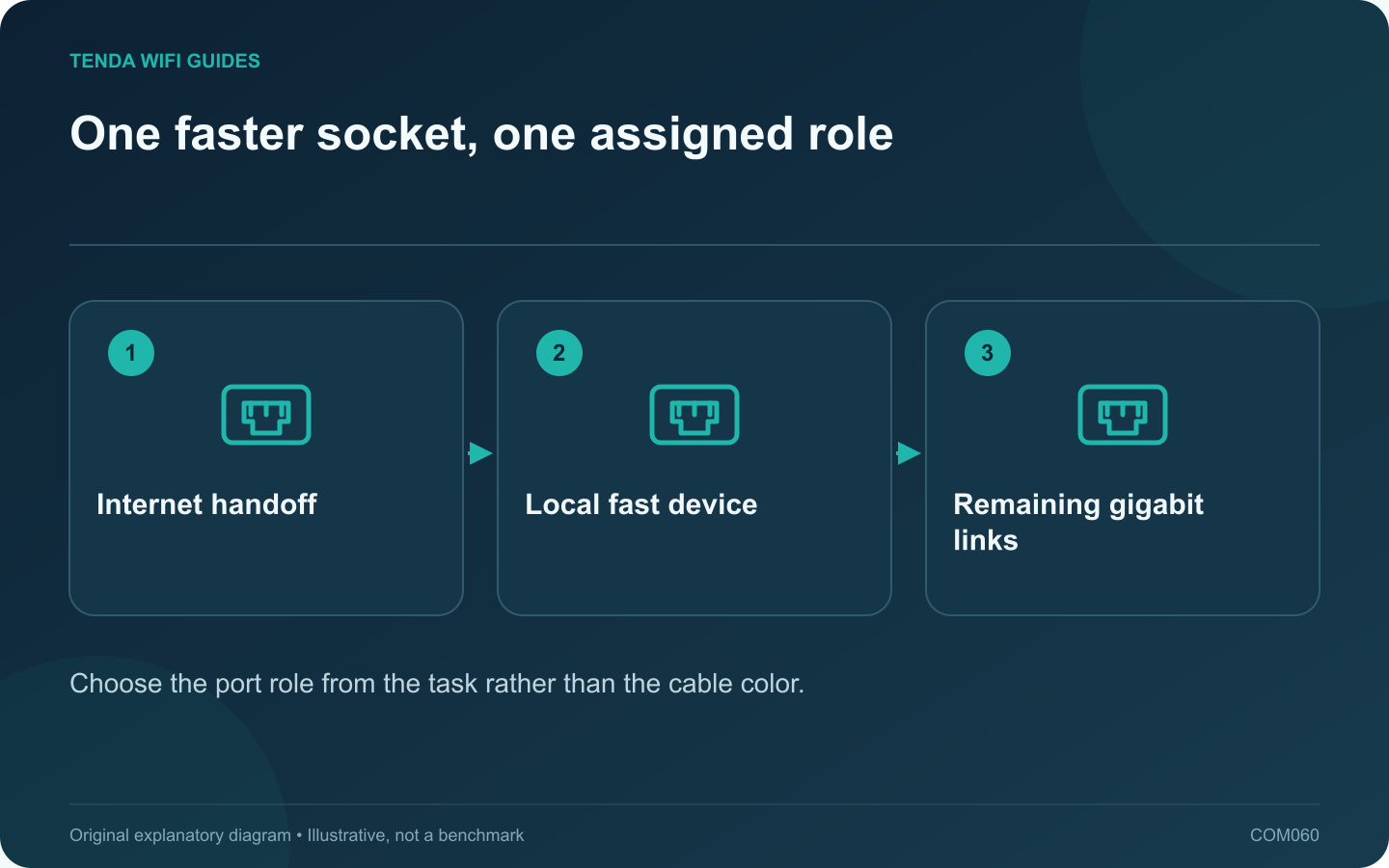
One faster socket, one assigned role: Internet handoff; Local fast device; Remaining gigabit links
Choose the port role from the task rather than the cable color.

The TE6L Pro’s faster Ethernet interface deserves a deliberate assignment. If it is used for the internet feed, it is not also available as a separate faster local socket. Start by drawing the task whose performance you intend to improve.

Read the physical interface list

Tenda lists one 2.5 Gbps WAN/LAN interface and three gigabit WAN/LAN interfaces for this model. Verify your exact regional hardware and the supported port-role behavior in its current interface.

The labels describe interface capabilities. They do not guarantee an internet rate, and they do not make every remaining wired connection run at the fastest listed rate.

Compare two installation goals

  • Faster upstream service: confirm the provider equipment and service support the intended rate, then assign the appropriate WAN interface.
  • A fast local endpoint: check whether the supported operating mode and port assignment allow the intended local use, and trace the other endpoint’s connection.

If both the upstream link and a directly attached local device need separate faster interfaces, this port layout may not match the complete requirement. Do not assume adding a fast switch removes a slower router link in the route.

Inspect the negotiated connection

After wiring, use the available router or client status to check the actual negotiated link. If it is lower than expected, inspect the cable, far-end interface and port role before changing wireless settings.

Keep a note of which cable reaches which device. A short label at both ends is more useful than relying on a cable color that may change during maintenance.

Test the correct destination

Use an internet test for an upstream-service goal and a local transfer for a storage or workstation goal. Record the full path and keep the same endpoints for comparison.

Choose the layout that serves the real workload. A single 2.5G label on the case is one component of that plan, not a complete multi-gigabit network.

Sources and editorial notes

Sources checked 8 October 2026. Independent guidance and original illustrations; product comparisons use published specifications rather than hands-on benchmarks. Check the exact model, revision and regional documentation before changing settings.

Related guides

300 FAQs across our guide libraries

Quick answers

100 practical questions from Tenda WiFi Guides.

Browse all 100 FAQs
How should I allocate the TE6L Pro’s single 2.5G port?

The TE6L Pro's faster Ethernet interface deserves a deliberate assignment. If it is used for the internet feed, it is not also available as a separate faster local socket. Start by drawing the task whose performance you intend to improve. Tenda lists one 2.5 Gbps WAN/LAN interface and three gigabit WAN/LAN interfaces for this model. Verify your exact regional hardware and the supported port-role behavior in its current interface.

Read the full guide and sources
What should I check when assigning WAN ports on a W18E v2.0?

A small office needs a clear connection plan before a multi-WAN-capable router is installed. For W18E v2.0, decide how many internet feeds are actually required and how the remaining local equipment will connect. Flexible port roles do not create additional physical sockets. Tenda lists four gigabit Ethernet interfaces with configurable WAN/LAN arrangements for W18E v2.0. It also lists office-oriented functions such as captive portal and bandwidth controls. Verify the current hardware and documentation before selecting the product for a particular policy requirement.

Read the full guide and sources
What should I inventory before switching Nova MW6 to bridge mode?

Nova bridge mode can fit a home where an existing router must remain the gateway. Before switching, list the Nova functions you use and decide where they will be enforced afterward. The mode change is not merely another way to name the Wi-Fi network. Tenda's MW6 and Nova guidance describes bridge operation behind an internet-connected router and lists gateway-related features that become unavailable, including DHCP and several policy controls. Confirm the current behavior for your system and app version before relying on a feature after the change.

Read the full guide and sources
Which RX2 Pro operating mode should I plan before setup?

Choose the RX2 Pro's operating mode from the role it needs to perform. Is it the household gateway, an Ethernet-connected wireless access point, or a device repeating an existing wireless connection? Starting with that question avoids entering credentials into the wrong setup path. Tenda's RX2 Pro specification lists wireless-router mode, AP mode and universal repeater mode labeled Client+AP. That establishes available categories, but it does not mean every feature behaves identically in each one. Check the current guide for your hardware and firmware before switching.

Read the full guide and sources
Independent. Practical. Clear.

Tenda WiFi Guides is an independent information website. We are not affiliated with or endorsed by Tenda. Product names belong to their respective owners.