Independent setup & troubleshootingHelping you find your connection.
The guide library

Before moving smart-home devices to an IoT network

Explore the guide library · Smart-home networking

Map which devices need local discovery, controllers or cloud access before separating them from phones and computers.
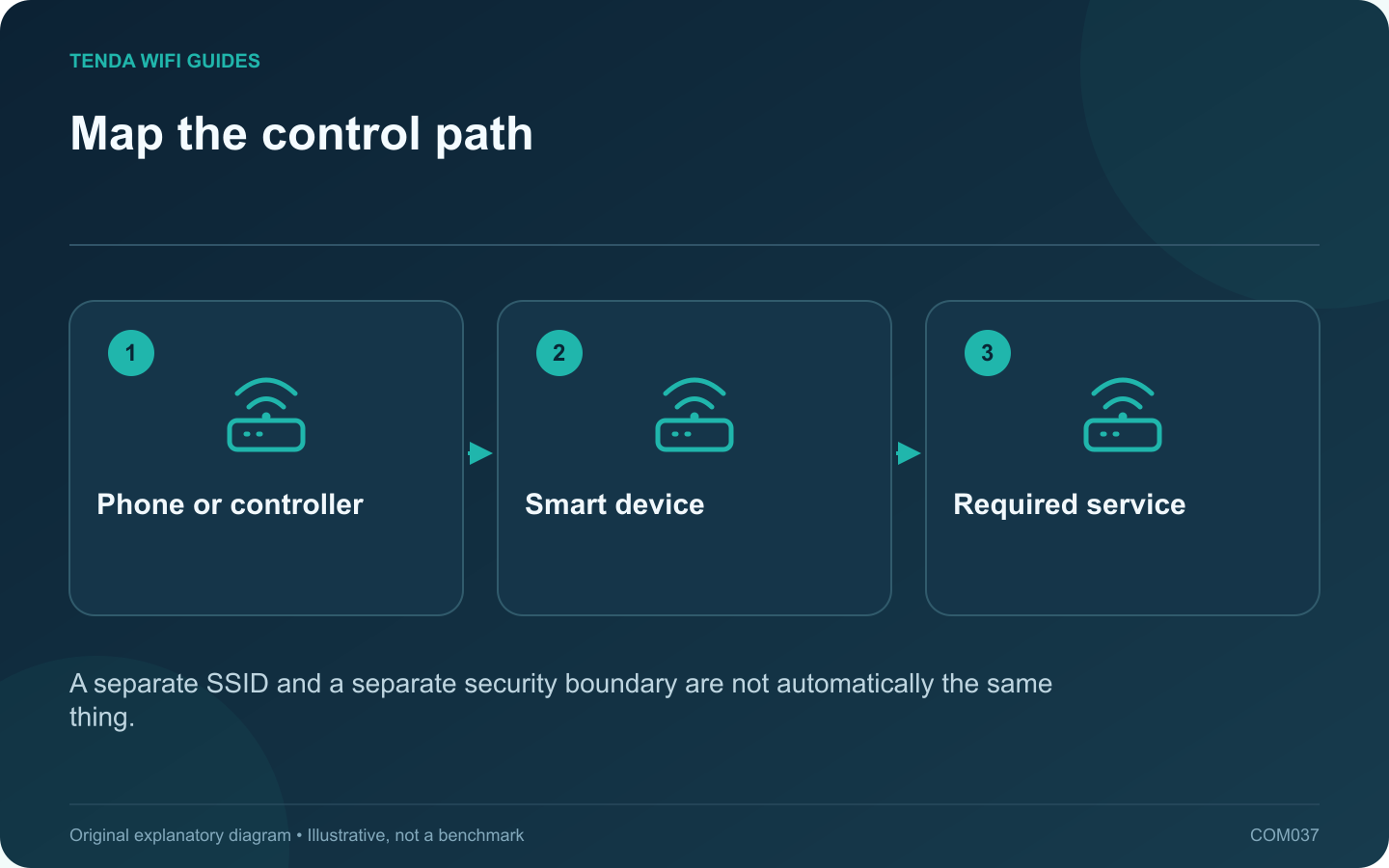
Map the control path: Phone or controller; Smart device; Required service
A separate SSID and a separate security boundary are not automatically the same thing.

An IoT network can make a smart-home installation easier to organize, but separation must preserve the communication the devices need. Start with a list of control paths. A device that only contacts a cloud service has different requirements from one discovered directly by a phone on the local network.

Record how each device is controlled

For every plug, speaker or sensor, note the app or controller, the transport and the features you use. Include local discovery, scheduled actions and access away from home. Do not assume that a working cloud app proves local automations also work.

The Connectivity Standards Alliance describes distinct controller and network roles in Matter. That is a useful reminder that the home Wi-Fi router may be only one component of the smart-home system.

Understand the router’s IoT feature

Read whether the product creates only another network name or enforces a separate network policy. If it uses guest-network controls, inspect isolation options and operating-mode limitations. GL.iNet’s guest documentation illustrates that client isolation is an explicit setting rather than an implication of the label.

Migrate one noncritical device

  1. Choose a device whose temporary disconnection will not affect an essential household function.
  2. Move it using its manufacturer’s supported network-change procedure.
  3. Test control from the usual phone, then test its normal schedule or automation.
  4. Check remote control separately if you use it.
  5. Confirm the device cannot access a private resource that your policy intends to block.

Resolve dependencies before expanding

If discovery fails, identify the documented local communication requirement. Do not immediately collapse every network boundary. A supported controller arrangement or carefully designed policy may be required; some consumer routers cannot express the necessary exception.

Keep the original network details and recovery instructions available during migration. Expand the IoT network only after the first representative device passes its actual tasks. The goal is a maintainable security boundary with working controls, not simply moving icons into a new app category.

Sources and editorial notes

Sources checked 8 October 2026. Independent guidance and original illustrations; product comparisons use published specifications rather than hands-on benchmarks. Check the exact model, revision and regional documentation before changing settings.

Related guides

300 FAQs across our guide libraries

Quick answers

100 practical questions from Tenda WiFi Guides.

Browse all 100 FAQs
What should I test before moving smart devices to an IoT network?

An IoT network can make a smart-home installation easier to organize, but separation must preserve the communication the devices need. Start with a list of control paths. A device that only contacts a cloud service has different requirements from one discovered directly by a phone on the local network. For every plug, speaker or sensor, note the app or controller, the transport and the features you use. Include local discovery, scheduled actions and access away from home. Do not assume that a working cloud app proves local automations also work.

Read the full guide and sources
How should I compare Thread and Wi-Fi smart devices?

Choose a smart-home accessory by the task it must perform and the infrastructure you can maintain. Thread and Wi-Fi serve different design needs, and neither label alone guarantees a better product. A sensor, a camera and a wall-powered display have different power and traffic requirements. Thread Group describes Thread as an IP-based network suited to low-power devices, while Matter can use several network transports. For a buying decision, translate that into concrete questions: how is the accessory powered, what information does it exchange, and which controller or border-router role does it require?

Read the full guide and sources
Do a Matter controller, Thread border router and Wi-Fi router do the same job?

A Matter controller, a Thread border router and a home Wi-Fi router perform different jobs. One product may combine several roles, which makes shopping descriptions confusing. Start with the accessory's requirements and inventory the roles already present in your home. The Connectivity Standards Alliance describes controllers that manage Matter devices and border routers that connect Thread devices to other IP networks. Thread Group explains that Matter can operate over Thread, Wi-Fi or Ethernet. A Matter logo alone therefore does not tell you whether the accessory joins Wi-Fi.

Read the full guide and sources
How do I move a Nest speaker or display to a new router?

When a new router uses different wireless credentials, a Nest speaker or display needs to join the replacement network. Keep the Google account and device identity straight before changing anything. Reconfiguring Wi-Fi is different from transferring the device to another household or account. Confirm that the phone running Google Home uses the account associated with the device. Note the device's room, name and any routines you rely on. Keep the new network credential ready, and verify that the phone can join that network successfully.

Read the full guide and sources
Independent. Practical. Clear.

Tenda WiFi Guides is an independent information website. We are not affiliated with or endorsed by Tenda. Product names belong to their respective owners.