Independent setup & troubleshootingHelping you find your connection.
The guide library

Retiring an old router: remove settings before selling or recycling it

Explore the guide library · Tenda maintenance

Keep the recovery information you still need, remove the old device from service and follow its documented reset process before transfer.
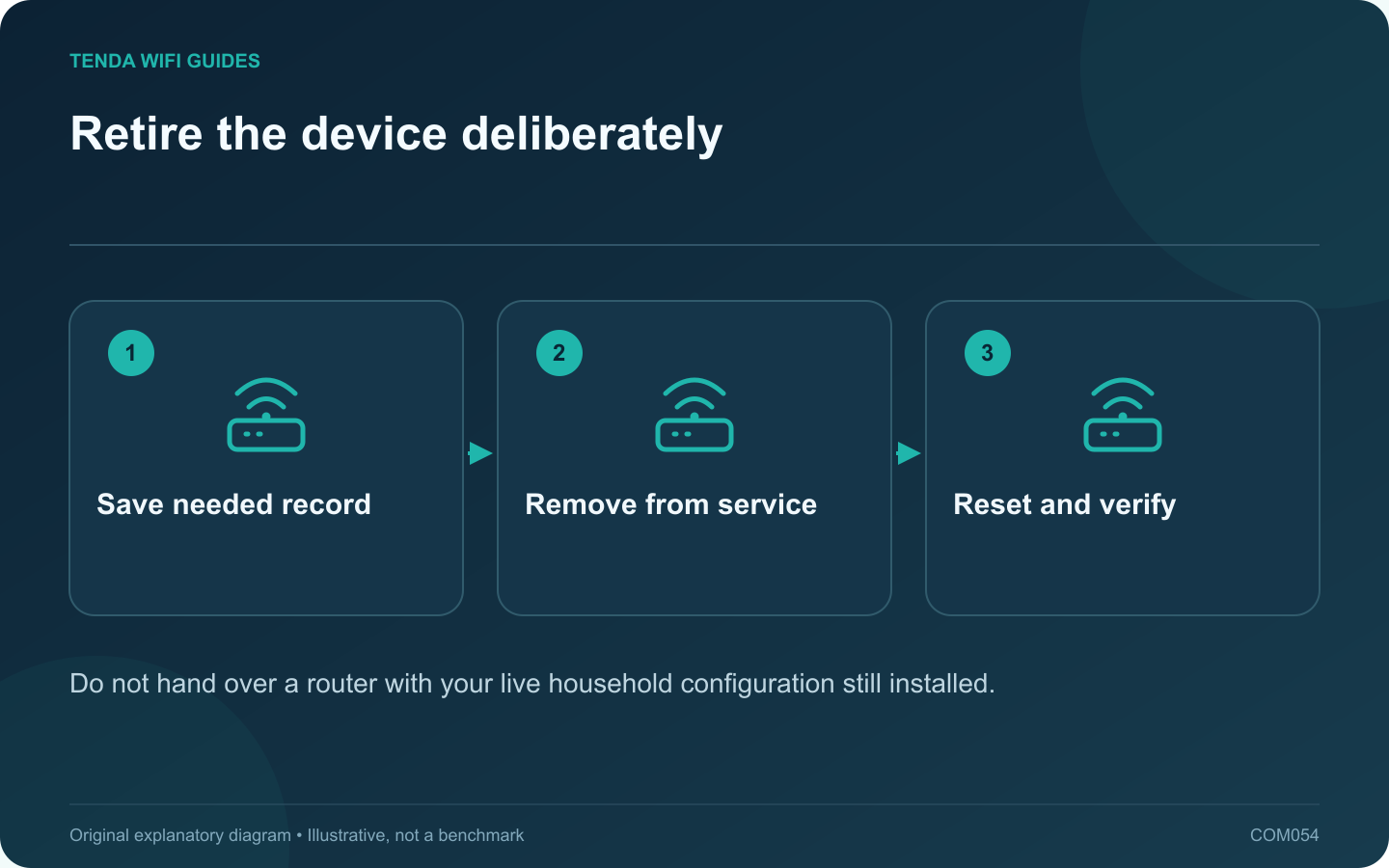
Retire the device deliberately: Save needed record; Remove from service; Reset and verify
Do not hand over a router with your live household configuration still installed.

An old router can retain network names, credentials and other configuration details after you stop using it. Before selling, donating or recycling it, preserve only the information you still need and follow the manufacturer’s documented reset process for that exact model.

Confirm the replacement is working

Keep the old router available until the new network passes ordinary household tasks. Test printers, storage and smart devices as well as internet access. Once the replacement is accepted, disconnect the old router from the service path and label it as retired.

Save the useful private record

Retain a configuration backup only if you have a legitimate recovery need and can store it securely. Keep a readable record of settings that were migrated, then remove obsolete access rules from the active network.

Tenda documents model-specific backup and revision-specific support resources. Use the manual for the retired hardware rather than assuming all reset buttons use the same timing or indicator sequence.

Remove account associations where applicable

If the product was connected to a management account or mesh system, follow its supported removal process. Resetting local settings and removing an account association may be separate operations. Verify the manufacturer’s instructions for the actual product.

Reset and inspect

  1. Use the documented factory-reset procedure with a stable power supply.
  2. Allow the reset and restart to finish.
  3. Confirm the old household network name is no longer broadcast by that unit.
  4. Inspect the supported initial-setup state without entering your live credentials again.
  5. Remove private labels or notes attached to the device or packaging.

Do not assume a reboot, unplugging or changing the Wi-Fi name erased the configuration. Those are different actions.

Transfer responsibly

Disclose the model, revision and maintenance status accurately to a recipient. If the product is unsuitable for continued use, use an appropriate electronics recycling route. Keep any retained backup private; it should not accompany the device to a new owner.

Sources and editorial notes

Sources checked 8 October 2026. Independent guidance and original illustrations; product comparisons use published specifications rather than hands-on benchmarks. Check the exact model, revision and regional documentation before changing settings.

Related guides

300 FAQs across our guide libraries

Quick answers

100 practical questions from Tenda WiFi Guides.

Browse all 100 FAQs
What should I remove before selling or recycling a router?

An old router can retain network names, credentials and other configuration details after you stop using it. Before selling, donating or recycling it, preserve only the information you still need and follow the manufacturer's documented reset process for that exact model. Keep the old router available until the new network passes ordinary household tasks. Test printers, storage and smart devices as well as internet access. Once the replacement is accepted, disconnect the old router from the service path and label it as retired.

Read the full guide and sources
Why save a Tenda RX27 Pro configuration before changing it?

A configuration backup is most useful when it represents a known-working setup and you can identify the device it belongs to. Before a major RX27 Pro change, save both the supported configuration export and a short human-readable record of the network roles. The cited RX27 Pro manual places backup and restore under More, System Settings, then Backup & Restore. Verify that the model, revision and interface match your device. Do not assume the same file or menu applies to another Tenda router.

Read the full guide and sources
Why keep screenshots as well as a router backup file?

A router configuration export and a set of private notes solve different problems. The export can support a documented restoration. The notes explain what the network is supposed to do and help when moving to a different device that cannot import the file. Write down the model, hardware revision, firmware, operating mode and wiring. Add the LAN address plan, reservations, guest policy and any intentionally configured forwarding or VPN rules. Keep passwords in a suitable secure record rather than placing them throughout screenshots.

Read the full guide and sources
Is a daily router reboot a good solution to instability?

A daily restart can interrupt a recurring symptom without explaining it. Before making reboots routine, record what fails, when it fails and what the router reports. That evidence may reveal a firmware issue, an upstream outage, overheating or one problematic client. When the fault occurs, check whether it affects all clients, only Wi-Fi or only one application. Note whether local router management still works. Save relevant logs through the supported interface before a restart clears useful information.

Read the full guide and sources
Independent. Practical. Clear.

Tenda WiFi Guides is an independent information website. We are not affiliated with or endorsed by Tenda. Product names belong to their respective owners.